The loop pays you now.
Going over a worry can feel like preparing or staying in control (Borkovec & Roemer, 1995).
EvidenceMixedTrials / Overthinking
Trial No. 03 · The complete experiment
What happens when you stop solving it in your head?
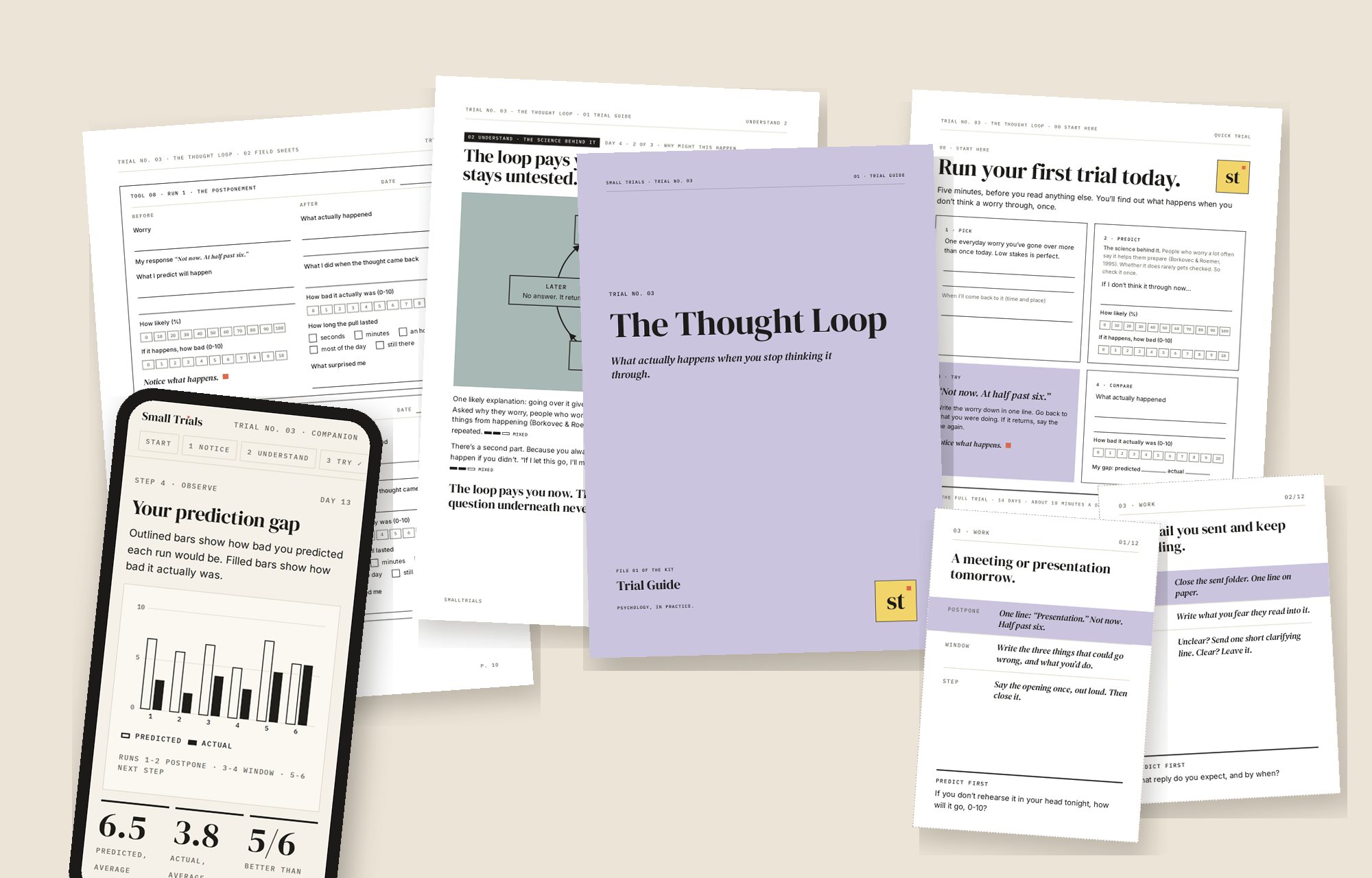
Digital field kitInstant downloadPhone and paper
An experiment for people whose thinking keeps going round. You don’t try to stop your thoughts. You test what happens when you postpone them, give them a set time, or turn them into one step.
Smallest step first, on purpose. A step that feels doable gets done, and each run you complete makes the next one feel more possible.
€28incl. VAT · Instant download · Yours to keep
Run the trialUse everyday worries only. Not for thoughts about harming yourself or memories of something traumatic. If worry is constant, keeps you awake most nights or comes with panic, please talk to a doctor or psychologist.
The film · 20 seconds
From the old pattern to the prediction gap. Sound on if you like.
Experiment Lab
Optional tests that look at the same pattern from another side. Try three of them here.
Why it keeps happening
A “what if” shows up and you go over it again. It feels like preparing, so it feels useful. No answer comes, and the loop returns.
Going over a worry can feel like preparing or staying in control (Borkovec & Roemer, 1995).
EvidenceMixedAbstract, evaluative thinking (“why does this always happen?”) tends to keep repetitive thought going (Watkins, 2008).
EvidenceMixedIn one small study, people tracked their worries for a month and most did not come true (LaFreniere & Newman, 2020).
EvidenceEarlyWhat happens after 14 days?
The kit is yours to keep. Run it again when the pattern comes back, with a harder situation or a different person. The companion tool keeps working offline.
How much time?
About ten minutes a day, for 14 days. The runs happen in moments you were going to have anyway.
Paper or phone?
Both. The Field Sheets work printed or filled in on screen. The companion tool works offline on your phone, and your notes stay on your device.
Find out in 14 days.