One more check pays you now.
Checking and polishing lower doubt for a moment, so they get repeated (Shafran, Cooper & Fairburn, 2002).
EvidenceMixedTrials / Perfectionism
Trial No. 04 · The complete experiment
What happens when you stop at good enough?
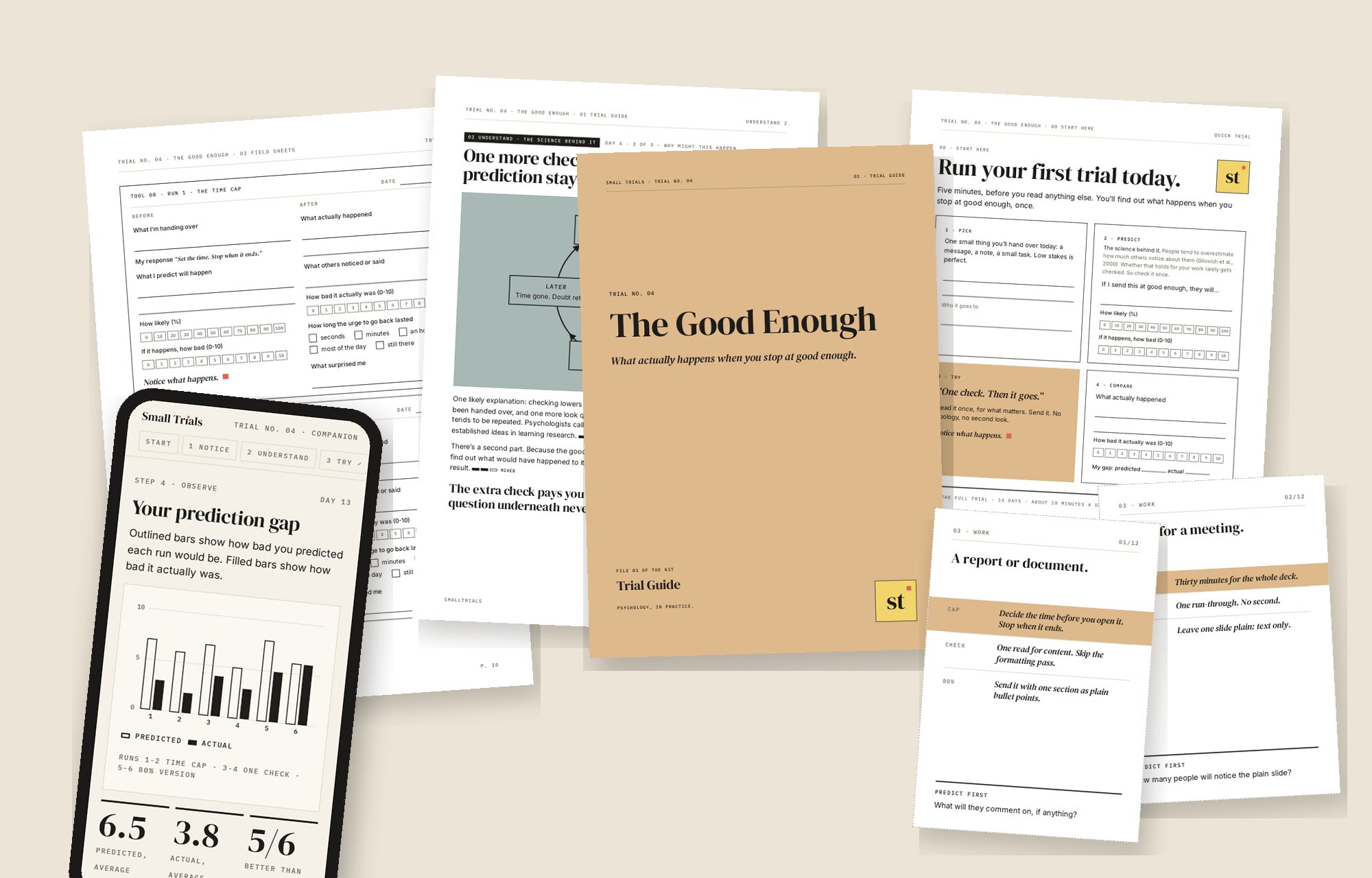
Digital field kitInstant downloadPhone and paper
An experiment for people who keep polishing what was already fine. High standards aren’t the problem. You test what the last round of checking really adds, and who notices when it’s gone.
Smallest step first, on purpose. A step that feels doable gets done, and each run you complete makes the next one feel more possible.
€28incl. VAT · Instant download · Yours to keep
Run the trialUse everyday tasks only. Not for work where a mistake could harm someone. If perfectionism is tied to food, weight or appearance, or comes with persistent low mood or exhaustion, please talk to a doctor or psychologist.
The film · 20 seconds
From the old pattern to the prediction gap. Sound on if you like.
Experiment Lab
Optional tests that look at the same pattern from another side. Try three of them here.
Why it keeps happening
Something has to go out, and you take one more look. The doubt drops for a moment. The time is gone, and the doubt comes back with the next task.
Checking and polishing lower doubt for a moment, so they get repeated (Shafran, Cooper & Fairburn, 2002).
EvidenceMixedPeople tend to overestimate how much others notice about them, including their mistakes (Gilovich, Medvec & Savitsky, 2000).
EvidenceMixedIn randomised trials, cognitive-behavioural approaches reduced perfectionism (Galloway et al., 2022).
EvidenceMixedWhat happens after 14 days?
The kit is yours to keep. Run it again when the pattern comes back, with a harder situation or a different person. The companion tool keeps working offline.
How much time?
About ten minutes a day, for 14 days. The runs happen in moments you were going to have anyway.
Paper or phone?
Both. The Field Sheets work printed or filled in on screen. The companion tool works offline on your phone, and your notes stay on your device.