Psychology, in practice.
You don’t need to become a different person.
Test a different response.
What this is
Small Trials turns psychological insight into small experiments you can run in an ordinary week. Instead of trying to change who you are, you test one different response and see what actually happens.
Created by a psychologistNot therapyNot a course
Photo · to shoot
Close-up from above: a hand writing a prediction on an index card at a desk. A phone lies face down beside it, a cup just out of frame. Morning light, no face.
How it works
Five steps.
Every trial.
No new habits to keep up. No streaks. One small experiment, run the way a scientist would run it.
- 01Notice
Catch the response that happens on its own.
- 02Understand
See what the old response gets you, and what it costs.
- 03Try
Predict first. Then do one thing slightly differently.
- 04Observe
Put your prediction next to what actually happened.
- 05Adjust
Keep what worked. Change what didn’t. Run it again.
Every try starts with a prediction. A vague expectation can’t be wrong, so it can’t teach you anything.
Try it freeWhy small
Small enough to try.Specific enough to notice.Useful enough to change something.
Big plans ask you to become someone else first. A small trial only asks for one moment this week.
Free 3-day mini trial
The Small No.
Three short emails, a few minutes a day. One small, low-stakes no. And a result that’s yours, not ours.
Day 01
Notice.
Catch three yeses you gave before you’d decided. Change nothing yet.
Day 02
Predict.
Pick one situation coming up. Write down what you think will happen.
Day 03
Try.
Say one small no, somewhere the stakes are low. Then stop talking.
Then
What actually happened?
Not sure saying yes is your pattern?
Take the Loop Check.
Checking things that were already fine. Thinking in circles. Putting off the thing that matters. Five minutes to find the loop you keep repeating, and the free mini trial that fits it.
No account. Your answers stay in your browser.
Take the Loop CheckTrial No. 01 · The complete experiment
The Delayed Yes.
Digital field kitInstant downloadPhone and paper
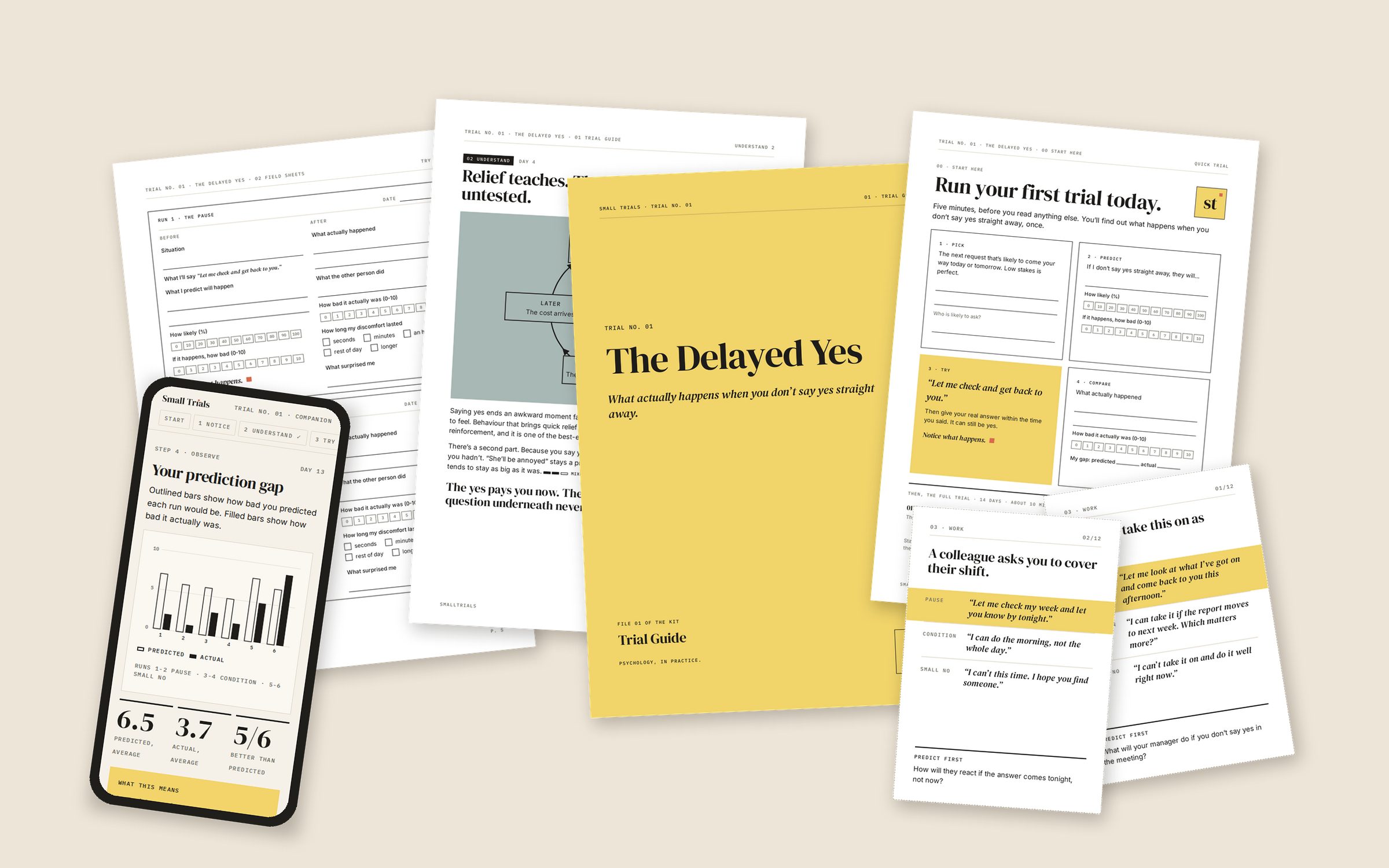
An experiment in what happens when you stop saying yes on autopilot. You don’t practise saying no. You practise one sentence, “Let me check and get back to you,” and you check what it actually costs.
- NoticeLog the yeses you give before you’ve decided, and what each one buys you.
- UnderstandWhy the fast yes is so hard to drop, with an honest evidence label on every claim.
- TrySix runs over 14 days: two pauses, two conditions, two small nos. A written prediction before each one.
- ObserveYour prediction gap, drawn from your own data.
- AdjustKeep, tweak or drop each response. Then set your next step.
- 00Start Here, a first trial on day one
- 01Trial Guide, 14 pages
- 02Field Sheets, fillable or printable
- 03Scenario Cards, 12 situations
- +Companion tool for phone or laptop
- +Phone wallpaper with your three lines
€19incl. VAT · Instant download · 14-day refund
Run the trialNot therapy, and not meant for situations where saying no could make you unsafe.
Is it a course?
No. It's an experiment you run in your own week. There's reading, but most of the kit is for writing down what you expect and what happened.
How much time?
About ten minutes a day, for 14 days. The runs themselves take seconds. They happen in conversations you were going to have anyway.
Paper or phone?
Both. The Field Sheets work printed or filled in on screen. The companion tool works offline on your phone, and your notes stay on your device.
Photo · to shoot
Nadia at her desk, seen from the side or from behind. Hands on a notebook, a trial card in view. No face.
Who makes this
Made by a psychologist.
Small Trials is created by Nadia Berhmoun, a work and cognitive psychologist from Belgium. Every day she works with people and organisations on the gap between knowing and doing. Small Trials is what she'd hand you after that conversation: one small experiment, and an honest note about the evidence.
Two ways to start.
Trial No. 01
The Delayed Yes
The complete experiment. Three responses, six runs, and your prediction gap at the end.
Run the trialInsight is a hypothesis until you try it.
Don’t take our word for it. Run the trial.